
The Causative Agent, vol 8
8/29/2022 - The lifestyle issue. The three studies below show important lifestyle and behavioral changes that are associated with wellness and longevity.

Reducing alcohol consumption cuts cancer risk

It’s long been known that alcohol use is associated with an increased cancer risk, in a dose-dependent manner (the more you drink, the more of a risk it is). The cancers that are most closely associated with alcohol consumption are: esophageal, oral, laryngeal, pharyngeal, colorectal, liver and breast. There is little research, however, about how reducing or quitting drinking changes your cancer risk. A new study in JAMA followed a group in Korea over 6 years, some of whom decreased, increased or maintainted their alcohol intake and compared the levels of cancer diagnoses across the groups.
4.5 million Korean adults (40+ years old) were assessed for their alcohol consumption in 2009, 2011 and in 2013 and placed into the following groups at each time point: nondrinker, sustainer, increaser, reducer or quitter. Rates of cancer diagnoses for both alcohol-related cancers (listed above) or any type of cancer were compared.
The increaser groups had the highest level of all cancer diagnoses, and it was dose-dependent. For example, the group that went from nondrinker to moderate- or heavy-drinker had a higher risk than those that went from nondrinker to mild-drinker. Those that reduced their consumption, or quit entirely, reduced their cancer risk compared to sustainers (with one exception). *Suprisingly, moderate- and heavy-drinkers who quit completely saw an increase in their cancer rates between 2009 and 2011. The authors hypothesize that these people may have quit because they started to become ill with alcohol-related symptoms or cancer. This odd association seems to go away at the 2013 assessment, though. If the moderate/heavy drinkers who quit in 2011 stayed alcohol free to 2013, then their cancer risk went back down to baseline.*
Some of the cancers that are not traditionally associated with alcohol use that were especially relevant in this study: the non-drinkers that became drinkers had an increase in stomach, liver, gall bladder and lung cancers, as well as multiple myeloma and leukemia.
The authors of this study did attempt to control for income level, smoking status, physical exercise and comorbidities (like hypertension or diabetes) however they did not take into account other beneficial health behaviors that may have emerged when someone quits drinking (like eating a healthier diet or getting better quality sleep). The study did not take into account the presence of the alcohol-dehydrogenase mutation which is common in East Asia and is associated with alcohol use and cancer risk. However, the large size of the study population is definitely a strength.
The HotTake: Any reduction in alcohol consumption (going from heavy to moderate, or moderate to mild) or quitting alcohol entirely, is associated with a reduced risk in all types of cancers. Conversely, any increase in alcohol consumption is associated with an increase in cancer risk. Some moderate or heavy drinkers who quit saw a temporary increase in their cancer risk (see * above), but that risk seemed to disappear across more time. This is important information for alcohol moderation or cessation programs and for counseling of those considering reducing their intake.
Association Between Changes in Alcohol Consumption and Cancer Risk
Extending life-span with “just enough” sleep.

We all know that we need a good night of sleep. We have more energy, we can think more clearly and have more patience. It also improves our immune system, memory storage and retrieval, learning, and healing. Now, a study in Canada shows that the optimum amount of sleep can actually extend your life as well.
9,248 Canadians (age 18-80 years old) were assessed to determine if they met the sleep recommendations, exceeded it, or were below it. For those 18-64 years old, the sleep recommendation was 7-9 hours per night. For those 65+, the recommendation was 7-8 hours per night. Under-sleepers were defined as anyone getting less than 7 hours per sleep a night. Over-sleepers were defined as anyone getting more than 9 hours per night (if under 65 years old) or more than 8 hours per night (if over age 65).
They then calculated the impact of sleep on lifespan by taking into account the relative risk of dying of any cause in each of the sleep categories and the probability of death during each year in this Canadian population. These types of statistical analyses are not in my background, so I cannot speak to their accuracy.
The researchers found that those in the “met sleep recommendations” category had a lifespan of 1.2 years longer than the under-sleepers and, surprisingly, 2.6 years longer than the over-sleepers. This effect was most prevalent in the younger population, and seemed to mitigate as a person got older. By the time you reach age 80, meeting sleep recommendations will net you 0.7 more years of life compared to under-sleepers and 0.75 more years compared to over-sleepers.
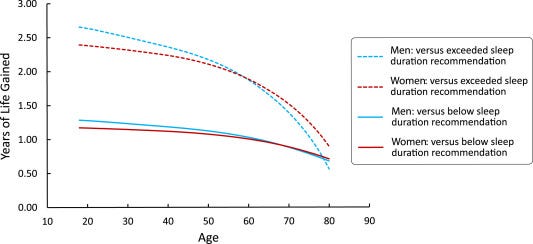
The HotTake: Getting 7-9 hours of sleep each night has the capacity to extend your life span by 1.5-2.6 years (compared to under- or over-sleepers) but only if you start young (age 20). If you start meeting sleep recommendations later in life, it is still beneficial, but not as profound. While 1-2 years may not seem like a huge increase, it is pretty impactful that just this one behavior can give you an extra year or so of life. Compare that to vegetarianism, which is also associated with a 1.5 year increase in life expectancy. Certainly getting a good night sleep is more accessable to most people than becoming a vegetarian, and the benefits to longevity seem to be about the same (or even more profound for those that are not over-sleeping).
Years of Life Gained When Meeting Sleep Recommendations in Canada
Having active leisure activites improves longevity for older adults
Well, duh. I’m sure we all knew that, but here’s the actual science!
272,550 adults between the ages of 59 and 82 (average age 70), were followed for 12 years. They were grouped based on the average amount of physical leisure activity they particpated in each week: none, moderately active (less than 7 MET hours/week), active (7-15 MET hours/week), highly active (15-22.5 MET hours/week) and very highly active (22.5+ MET hours/week). A MET (metabolic equivalent) is the ratio of your metabolic rate while exercising compared to the rate at rest. A MET of 1 would be just sitting down (your basal metabolic rate). A MET of 5 would be the amount of activity that exerts 5 times as much energy as you burn just sitting down.
They tried to control for confounding factors like age, sex, racial/ethnic groups, education level, smoking status, BMI, alcohol use, marriage status, and history of certain medical issues like stroke or diabetes. They also tried to control for non-leisure time activities (just how active you are in your daily life, like grocery shopping or housekeeping) and weight lifting.
The leisure time activities they studied were, in order of prevalence: walking (78%), other aerobic activity (30%), cycling (25%), golf (14%), swimming (10%), running (7%), and raquetball (4%).
They found that participating in active leisure time activity reduced the chances of dying for any reason, and it was dependent on how much activity you got. Those who got less than 7 MET hours per week had a 5% less chance of dying than the non-active group, and those who got 7-15 MET hours per week had a 13% less chance of dying than the non-active group. Highly active (greater than 15 MET hours/week) also saw a decrease in mortality rate relative to the other groups, but the difference was not as pronounced as the difference between non and moderately active. They also parsed out the death rates: death due to cancer, cardiovascular issues, and all causes of death. Physical leisure activity reduced deaths across the board, but more effect was seen on deaths due to cardiovascular issues than due to cancer.
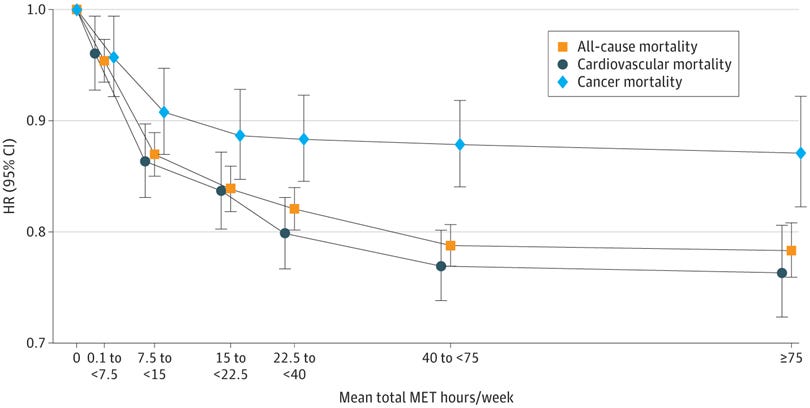
Some other interesting tidbits from this study:
In the moderately active group (7.5-15 MET hours):
Playing raquetball and running had the greatest reduction in mortality
Playing raquetball had the greatest reduction in cardiovascular death
Running had the greatest reduction in cancer death
For those that were very highly active (greater than 22.5 MET hours):
HIGHER mortality rates were found in runners, swimmers and those doing other aerobic exercise (although the swimmers tended to be older and with a higher BMI, so that may explain that particular difference)
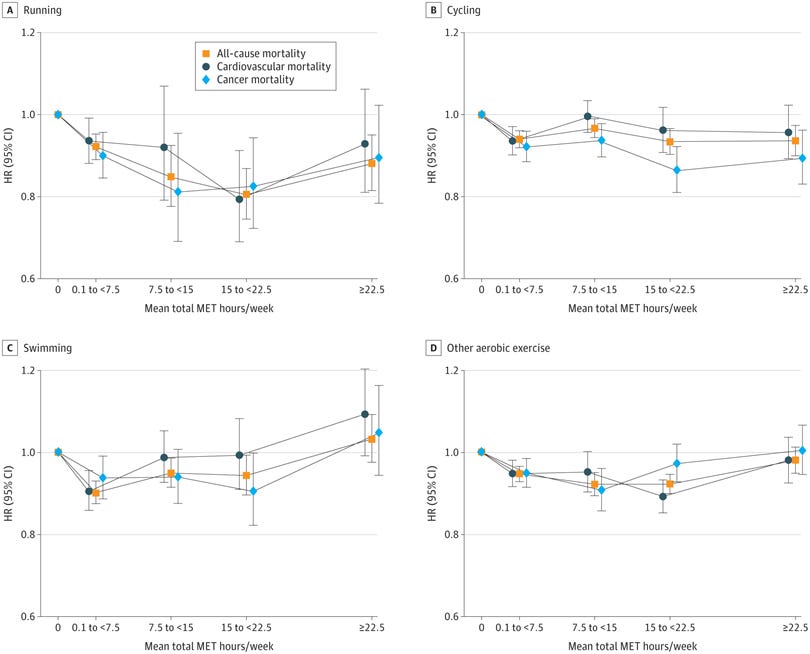
There were some gender differences:
Running had more of a positive effect on men, and didn’t seem to be statistically significant for women
Walking seemed to be more beneficial for women than men (although still beneficial)
The HotTake: Getting moderate physical leisure activity each week (7-15 MET hours) is associated with a decrease in mortality of all causes, but especially cardiovascular issues, in older adults. More activity is not necessarily better, especially when you get to the extremes. Raquetball seemed to have the greatest effect, possibly because of the synchronized activity of multiple parts of the body (for good form), because of the hand-eye-coordination needed, and/or the bursts of activity. However, the authors noted that ANY activity is better than no activity, so they recommend that all older adults participate in some kind of physical leisure activity if they are medically able.
Stay happy, healthy and informed for longevity!
Jessica at The Causative Agent